


AI and interactive technology at school events in Kerala: the rules
Not legal advice. POCSO and the IT Act's data-security provision apply now; the DPDP Act's children's duties start about 13 or 14 May 2027 (our estimate). We found no Kerala circular on outside providers running camera or AI activities, and most school-safety guidance is advisory.
Key findings
- 01 About May 2027
The DPDP Rules' children's-data provisions, including Rule 10 on verifiable parental consent, start eighteen months after Gazette publication: 13 May 2027 if the Gazette is dated 13 November 2025, as the Rules' heading reads, or 14 May 2027 on PIB's date of 14 November 2025 (our arithmetic; the Gazette was not opened).
Estimate Source 2 - 02 Now
Section 43A of the IT Act, which makes a body corporate that is negligent in maintaining reasonable security practices for sensitive personal data, and thereby causes wrongful loss or gain, liable to pay compensation, is in the Act now and stays until s.44(2) of the DPDP Act comes into force, which TeamLease RegTech places eighteen months after the commencement notification of 13 November 2025 (about 13 or 14 May 2027, our estimate).
Reported Source 13 - 03 s.2(1)(da)
The POCSO Act, in the NCPCR copy last updated on 28 February 2023, defines child pornography as any visual depiction of sexually explicit conduct involving a child, including computer-generated images indistinguishable from an actual child and images created, adapted or modified to appear to depict a child.
Verified Source 7 - 04 s.23
On its words, s.23 of the POCSO Act does not prohibit photographing children; it governs reports and comments about a child, and disclosing a child's identity, including by photograph, in media reports.
Verified Source 7 - 05 Rule 3(4)
India's POCSO Rules, notified on 9 March 2020, require an institution in regular contact with children, including a school, to ensure periodic police verification and background checks of its staff and employees; the text does not settle whether this reaches an outside vendor's crew.
Verified Source 8 - 06 February 2026
As summarised by Shardul Amarchand Mangaldas, the IT Rules amendment notified on 10 February 2026 and effective 20 February 2026 puts its labelling and provenance duties for synthetic content on intermediaries, and on significant social media intermediaries for user declarations.
Reported Source 9 - 07 Rs 200 crore
The Press Information Bureau (Government of India) lists a penalty of up to Rs 200 crore (2,000 million rupees), about US$21.3 million at 93.93 rupees to the dollar on 16 November 2026, for violations of obligations relating to children under the DPDP Act; the Act's Schedule (item 3) ties this to the additional obligations in relation to children under s.9, which are not in force until about May 2027.
Verified Source 4 - 08 No figure published
No directly applicable Kerala circular on outside providers running camera, photography or AI activities in schools was identified in the sources accessible on 17 November 2026: General Education Department orders and circulars pages 1 and 2 (titles only), 192 KITE circular titles and Samagra Shiksha Kerala notices were read; the Kerala child rights commission (403 and DNS failure), women and child development (403), cbse.gov.in (403) and cisce.org (403) sites could not be read.
Not published
Version 2, revised 17 November 2026. Next scheduled review: 13 February 2027.
This study is not legal advice. It records what public laws and guidance say about outside providers running camera, AI or app-based activities with pupils aged 4 to 17 at school events in Kerala, read on 17 November 2026. It shows which laws exist, not how they apply to a particular provider. Take advice from an Indian lawyer practising in child protection and data protection.
What should a school decision-maker know first?
- POCSO (the child sexual offences law), IT Act s.43A and the 2011 SPDI Rules are in force now. The DPDP Act’s children’s duties start about 13 or 14 May 2027 (our estimate). Privacy obligations do not wait for that date.
- POCSO s.23 does not, on its words, prohibit photographing children. Whether Rule 3(4) reaches an outside crew is open.
- The 2026 IT Rules duties on synthetic content attach to intermediaries; an offline provider’s status is unsettled.
- We found no Kerala circular on outside providers.
When do the DPDP children’s duties start, and what applies before then?
Section 9 of the DPDP Act, on children’s data, starts eighteen months after publication of the commencement notification [3]: about 13 or 14 May 2027 (our estimate). Other obligations are in force now. A lakh is 100,000 and a crore is 10 million; dollars use 93.93 rupees (Rs) to the dollar on 16 November 2026 [39].
We did not open the Gazette: egazette.gov.in showed a certificate error, and meity.gov.in and indiacode.nic.in returned 403. The Rules text on a private site is headed “G.S.R. 846(E) … the 13th November, 2025” [2]. The PIB backgrounder of 17 November 2025 says “DPDP Rules notified on 14 November 2025” [4]. If the Gazette date is 13 November 2025, as the Rules’ heading reads, eighteen months ends on 13 May 2027; PIB gives 14 November 2025, which would make it 14 May 2027. We could not open the Gazette to settle it.
Commencement is phased [2][3]. Rules 1, 2 and 17 to 21 started on publication; Rule 4 (consent managers) came into force one year after (about 13 or 14 November 2026, our estimate); Rules 3, 5 to 16, 22 and 23, and Act ss.9 and 44(2), start eighteen months after. Secondary sources differ on other sections, so we do not state them. A Removal of Difficulties Order of 5 October 2026 inserted the word “of” in s.9(1) and “data” before “audit” in s.10(2)(c)(ii); neither report says the Order changed any commencement date [5][6].
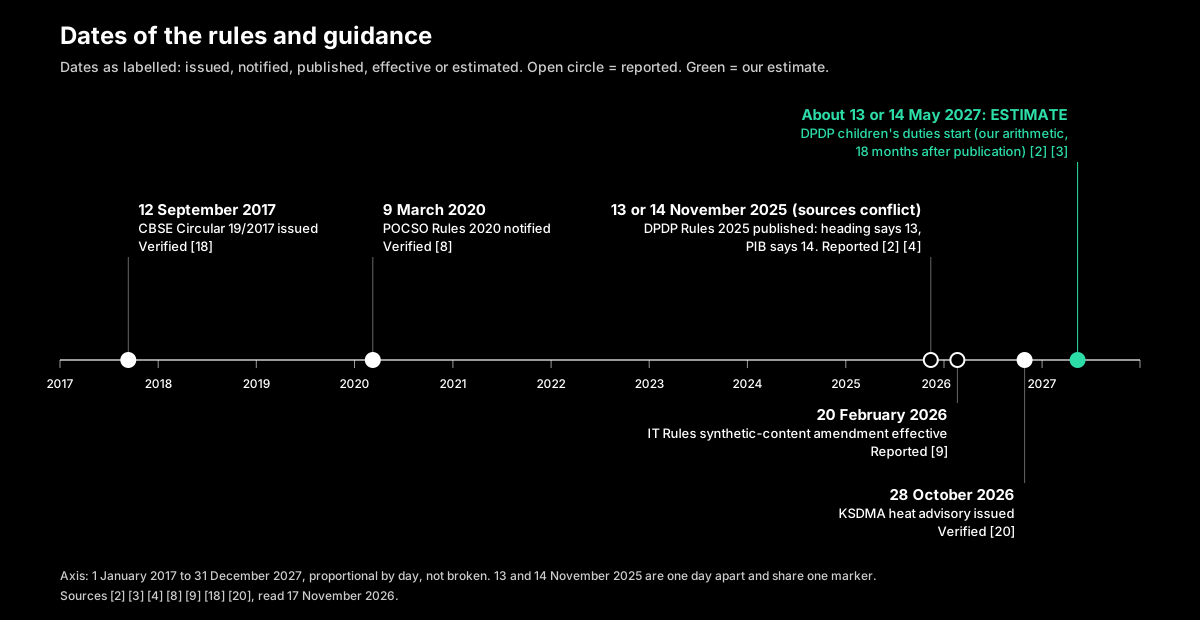
Figure 1. Dates of the rules and guidance, 2017 to 2027. Sources [2], [3], [4], [8], [9], [18], [20]. The May 2027 date is our estimate.
Obligations in force now:
- IT Act s.43A makes a body corporate liable to pay compensation if it is negligent in implementing and maintaining reasonable security practices for sensitive personal data and thereby causes wrongful loss or gain [13]. It stays in the Act until s.44(2) of the DPDP Act comes into force; TeamLease RegTech places that eighteen months after 13 November 2025, which we estimate as 13 or 14 May 2027 [3]. Our compilation is the 2021 text.
- SPDI Rules 2011: Rule 3 lists “Biometric information” as sensitive; Rule 2(1)(b) includes “facial patterns” for “authentication purposes”; Rule 5(1) needs written consent before collection [14]. Photographs are not listed, and the Rules say nothing about children. We do not say a photograph is sensitive data.
- POCSO applies now [7][8]. IT Act s.72A (disclosure in breach of a lawful contract) is untouched by DPDP s.44 [1][13]; we state no penalty.
From May 2027 a Data Fiduciary will have to obtain verifiable parental consent (s.9(1), Rule 10) and will be barred from tracking, behavioural monitoring and targeted advertising directed at children (s.9(3)) [1][2]. The Fourth Schedule exempts educational institutions only for processing “restricted to tracking and behavioural monitoring” for educational activities or safety [2]. PIB gives up to Rs 200 crore (about US$21.3 million) for violations of “obligations relating to children”; the Act’s Schedule (item 3) ties this to “additional obligations in relation to children under section 9” [1][4].
What does POCSO say about photographing, storing and publishing a child’s image?
POCSO does not, on its words, regulate taking an ordinary photograph at an event. It bites on identity disclosure and on sexually exploitative material [7].
| Subject | What the text says | Open question |
|---|---|---|
| Taking a photograph | On its words, s.23 does not prohibit photographing children. It governs reports and comments about a child, and disclosing a child’s identity, including by photograph, in media reports. | Is a booth or app “studio or photographic facilities”? |
| Processing and storing | Section 2(1)(da) includes computer-generated and modified images. Section 15 penalises storing or possessing pornographic material involving a child where it is not deleted or reported with an intention to share, where it is kept for transmitting or distributing, or where it is kept for a commercial purpose. Section 20 requires personnel of media, hotel, lodge, hospital, club or studio or photographic facilities who come across sexually exploitative material to report it to the police. It is a reporting duty, not a general photography rule. | Is an AI photo station within s.20? |
| Publishing and commercial use | Section 23(2): no report in any media shall disclose a child’s identity, “including his name, address, photograph, family details, school”. The publisher or owner of the media or studio or photographic facilities is jointly and severally liable for the acts and omissions of an employee (s.23(3)). Breach of s.23(1) or (2) is punishable with imprisonment of not less than six months, which may extend to one year, or fine, or both (s.23(4)). | Is a provider’s post or print a “report”? |
Rule 3(4) requires institutions “coming in regular contact with children including schools” to ensure periodic police verification of “every staff, teaching or non-teaching, regular or contractual, or any other person being an employee of such Institution” [8]. The list ends “or any other person being an employee of such Institution”. Whether an outside crew is covered is open. Rule 3(5) extends child protection policies to “any other agency working with, or coming in contact with children” [8].
What can a school reasonably ask any provider to show?
These are reasonable asks of any provider. They are not any company’s practice and not a list from any single rule.
| Ask | Anchor |
|---|---|
| Police verification of every crew member | POCSO Rule 3(4), the institution’s own staff, vendor reach open [8]; CBSE 19/2017 para 4(c) [18] |
| Identity and employment records | CBSE para 4(d), support staff from authorised agencies [18]; MoE 2021 staff verification procedure, reported [15] |
| Control of outsiders on site | CBSE para 4(f) [18]; NCPCR Manual, visitors and contractors [16] |
| A school-approved staff list; a named supervisor; no unsupervised contact with children; a written safeguarding undertaking | Not required by a rule we read |
| Consent route, retention, image ownership in writing | DPDP s.9 and Rule 10 from May 2027 [1][2]; SPDI Rule 5 now [14]; Copyright Act s.17(b) [10] |
| Flash and sound limits; access for a child with a disability | Benchmarks below [28][31]; RPwD Act s.16, s.46 [11] |
How do the 2026 IT Rules treat AI-generated images?
The synthetic-content duties attach to intermediaries. Whether an offline provider is one is not settled, and we found no official statement either way on 17 November 2026 (not found).
The amendment was notified on 10 February 2026 and took effect on 20 February 2026, as summarised by Shardul Amarchand Mangaldas; we did not read the Gazette text [9]. Synthetic content is audio or visual content artificially created to appear real [9]. An intermediary (IT Act s.2(1)(w)) is a person who “on behalf of another person receives, stores or transmits” a record [13].
| Provider | Position |
|---|---|
| Intermediary that offers a resource for creating synthetic content, or significant social media intermediary (SSMI) | Label clearly and prominently; embed permanent metadata or provenance “to the extent technically feasible”; an SSMI must obtain and verify a user declaration and label [9] |
| AI platform offered online | The summarised duties attach to an intermediary that offers such a resource; whether a given platform is one is a legal question [9][13] |
| Offline provider printing locally | Unsettled; no statement found |
| Provider publishing AI images online | Where it uploads to a significant social media intermediary, that platform must require users to declare whether content is synthetically generated, per the summary [9] |
We do not say labelling is a legal duty for an offline provider; UNICEF presents it as good practice. UNICEF (p.17) says “Companies should … watermarking AI-generated media” and “AI system developers should … open standards for content provenance and authenticity” [24].
Which AI and interactive activities at school events carry which risks?
Each activity engages different provisions. The table names them and says nothing about how often harm occurs.
| Activity | Law and guidance it engages |
|---|---|
| No identifiable data: fictional characters; animating a child’s paper drawing | Personal data is “any data about an individual who is identifiable by or in relation to such data” (DPDP s.2(t)) [1]. If no name, face or voice is captured, that may not be met. |
| Voice recording | Personal data if it identifies the child (s.2(t)); processing includes recording and storage (s.2(x)) [1]. SPDI lists “voice patterns” within biometrics for authentication [14]. We read no Indian or UNICEF text on voice. |
| Identifiable photographs: portrait, photobooth | DPDP covers non-digital data digitised later (s.3) [1]. POCSO s.23(2) names a photograph as an identity particular [7]. UNICEF (p.23): minimal collection, shortest feasible retention [24]. |
| Facial manipulation or age transformation | POCSO s.2(1)(da) covers computer-generated and modified images [7]. UNICEF (pp.18, 23): AI-generated child sexual abuse material, deepfakes [24]. SPDI lists “facial patterns” [14]. |
| Location or individual tracking: app-based hunts | DPDP s.9(3) bars tracking and behavioural monitoring of children from May 2027; s.2 defines neither [1][2]. UK ICO standard 10: geolocation off by default “unless you can demonstrate a compelling reason to do so”; standard 12: profiling. UK-only benchmark [27]. |
Which standards bind, and which are only benchmarks?
Only the first row is Indian law; the CBSE circular binds CBSE-affiliated schools through affiliation. The rest are benchmarks for physical installations, not complete specifications.
| Item | Type | Scope and status for a school event |
|---|---|---|
| DPDP Act and Rules [1][2]; POCSO Act and Rules [7][8]; IT Act and SPDI Rules [13][14]; IT Rules 2026 [9]; Copyright, RPwD and JJ Acts [10][11][12] | Binding in India | DPDP phased. IT Rules duties attach to intermediaries. DPDP, IT Act and SPDI texts read on private-host copies, IT Rules 2026 in a law-firm summary (reported). JJ s.74(1), as written, covers reports regarding an inquiry, investigation or judicial procedure. |
| CBSE Circular 19/2017 [18] | Board circular | Binds CBSE-affiliated schools through affiliation; breach may lead to disaffiliation (para 5) |
| MoE 2021, NCPCR Manual, NDMA 2016, KSDMA advisory [15][16][17][20] | Advisory government guidance | “Should”; the Manual is a compilation “for ready reference” |
| ITU-R BT.1702-3 [28]; WCAG 2.2 [29]; IEEE 2089-2021 [25] | Published technical standard | ITU: broadcast television, not binding (our label). WCAG: web content, W3C Recommendation of 12 December 2024. IEEE: age-appropriate digital services, text not opened. |
| WHO safe listening standard [30]; WHO 2019 and 2020 guidelines [32][33]; UNICEF AI guidance [24] | Voluntary guidance | WHO standard: status not stated on its page. WHO 2019: no more than 1 hour of sedentary screen time at ages 2 to 4. WHO 2020: limit sedentary time, particularly recreational screen time; no numeric limit. UNICEF: aimed at governments and business. |
| UK ICO children’s code [26][27] | Voluntary benchmark | Online services; statutory in the UK only (DPA 2018 s.123) |
- Flash: ITU-R BT.1702-3 treats a luminance change of 20 cd/m2 or more, with the darker image below 160 cd/m2, as potentially harmful, and does not permit more than three flashes in one second over more than 25% of the screen [28]. WCAG 2.3.1 allows no more than three flashes in one second unless below thresholds [29].
- Sound: WHO lists limiting average sound levels to 100 dB (LAeq, 15 min) among six features for venues and events [31]; neither WHO page mentions children.
What school-safety guidance applies in Kerala?
No directly applicable circular was identified in the sources accessible during this research. Guidance says what schools should do and is advisory unless stated.
- MoE (2021) says schools should have a staff verification procedure (reported, copy on a Manipur site) [15]. NCPCR names visitors and contractors [16]. NDMA (2016) says keep evacuation routes clear [17].
- CBSE asked schools to employ support staff only from authorised agencies and to control outsiders’ access (12 September 2017) [18]. SCC Online reported CCTV clause 4.7.10, 21 July 2025 [19].
- KSDMA (28 October 2026; our English rendering) says programmes that expose children to more sun “should be avoided or rescheduled” [20].
- Press, not orders we read: students not forced to attend events (Onmanorama, 21 April 2023) [21]; children not to serve food at events (Manorama News, 16 July 2026) [22]; guidelines against school advertisement boards using children’s images (Onmanorama, 28 March 2023) [23].
- KITE’s announcement page says its Cyber Safety Protocol for students 2026 supersedes the 2019 version, has instructions for heads, teachers, parents and students, and that schools are “mandated to conduct Cyber Safety Audit in schools at least twice a year” [34]. We did not read the protocol text, so we cannot say whether it covers outside providers. PTI via ThePrint (8 March 2026) mentions no photographs [35].
Search scope, 17 November 2026: General Education Department orders and circulars page 1 (20 Government Orders and 20 circulars, 14 July to 17 November 2026) and page 2 (Government Orders 16 June to 7 July, circulars 20 August to 19 September 2026), titles only, pages 3 onward not read [36]; KITE circulars, 192 titles [37]; Samagra Shiksha Kerala notices [38]. The Kerala child rights commission (403, DNS failure), women and child development (403), cbse.gov.in (403) and cisce.org (403) sites could not be read; district education offices were not searched. No Kerala child protection policy under POCSO Rule 3(5) was found.
What this means for a market entrant
- Take advice from an Indian lawyer practising in child protection and data protection on your role.
- Plan for May 2027 and for the obligations that exist now.
- Expect schools to ask for staff verification, written consent routes and a statement of what images and data are kept.
- Check the school’s board and any Kerala instruction before booking; we identified none on outside providers.
What we could not verify
All checks were on 17 November 2026.
- The Gazette, so the Rules’ publication date and notification G.S.R. 843(E). The IT Rules 2026 Gazette text and the Removal of Difficulties Order were not read.
- Whether a provider is a Data Fiduciary or a Processor, whether the Fourth Schedule exemption covers a vendor acting for a school [1][2], and who owns AI outputs: no official Indian statement found; Copyright Act s.2(d)(vi) names as author of a computer-generated work “the person who causes the work to be created” [10].
- The KITE protocol text, the Ministry of Education originals (404), CBSE circulars 01/2022 and 02/2009, and the 2023 text amending s.72A.
- UNICEF pages beyond those cited: “facial recognition” was not found in the pages read, and we make no claim about it. ICO pages and the WHO standard PDF returned 403.
- Peer-reviewed evidence on leaderboards and children: none opened (not found).
Sources
- 01 The Digital Personal Data Protection Act, 2023 (No. 22 of 2023)
- 02 Digital Personal Data Protection Rules, 2025, G.S.R. 846(E)
- 03 MeitY issued a notification regarding the commencement of the DPDP Act, 2023
- 04 DPDP Rules, 2025 Notified: A Citizen-Centric Framework for Privacy Protection and Responsible Data Use (Backgrounder, 17 November 2025)
- 05 DPDP (Removal of Difficulties) Order, 2026: What has been changed for Children's Data and SDF Audits
- 06 Centre issues Digital Personal Data Protection (Removal of Difficulties) Order, 2026 to clarify consent and audit provisions
- 07 The Protection of Children from Sexual Offences Act, 2012 (Act 32 of 2012), last update 28-02-2023
- 08 The Protection of Children from Sexual Offences Rules, 2020 (Gazette No. 141, 9 March 2020)
- 09 The Information Technology (Intermediary Guidelines and Digital Media Ethics Code) Amendment Rules, 2026, Legislative Update
- 10 The Copyright Act, 1957 (14 of 1957)
- 11 The Rights of Persons with Disabilities Act, 2016
- 12 The Juvenile Justice (Care and Protection of Children) Act, 2015
- 13 The Information Technology Act, 2000, as amended (compilation)
- 14 Information Technology (Reasonable security practices and procedures and sensitive personal data or information) Rules, 2011, G.S.R. 313(E)
- 15 Guidelines on School Safety and Security (2021)
- 16 Manual on Safety and Security of Children in Schools (2021)
- 17 National Disaster Management Guidelines: School Safety Policy (February 2016)
- 18 Circular No. 19/2017, Safety of Children in Schools (12 September 2017)
- 19 CBSE introduces Real-Time CCTV Guidelines for safer school environments
- 20 Temperature warning page (advisory issued 1.30 pm, 28 October 2026)
- 21 Curbs on taking students to attend events from new academic year
- 22 Kerala education dept bans engaging students in serving food at school events
- 23 Ban usage of children's images on school advertisements: Child Rights Commission
- 24 Guidance on AI and Children 3.0 (December 2025)
- 25 IEEE 2089-2021, IEEE Standard for an Age Appropriate Digital Services Framework Based on the 5Rights Principles for Children
- 26 Explanatory memorandum to the Age Appropriate Design Code 2020
- 27 Child online safety: data protection and privacy
- 28 Recommendation ITU-R BT.1702-3 (11/2023), Guidance for the reduction of photosensitive epileptic seizures caused by television
- 29 Web Content Accessibility Guidelines (WCAG) 2.2, Success Criterion 2.3.1 Three Flashes or Below Threshold
- 30 WHO global standard for safe listening venues and events
- 31 WHO hearing guidelines implemented at major arts festival
- 32 To grow up healthy, children need to sit less and play more
- 33 World Health Organization 2020 guidelines on physical activity and sedentary behaviour (Bull et al., Br J Sports Med 54(24), 1451-1462)
- 34 Cyber Safety Protocol for Students 2026 (announcement page)
- 35 Kerala unveils cyber safety protocol to safeguard students in AI era (PTI, 8 March 2026)
- 36 Government Orders and Circulars, General Education Department, Kerala
- 37 KITE circulars list
- 38 Samagra Shiksha Kerala notices
- 39 US dollar to Indian rupee cross rate for 16 November 2026
Method and limits
- Method
- Each law, guidance document and standard was opened on 17 November 2026 and read at the page level where it opened. The Gazette was not opened: egazette.gov.in returned a certificate error, and meity.gov.in and indiacode.nic.in returned 403, so statute and rule text is read on named private-host copies and graded reported. Sources are ranked in tiers, and each source's locator carries its tier: tier 1 Gazette or legislation; tier 2 government guidance; tier 3 regulator, board or department circulars; tier 4 court decisions (none used); tier 5 secondary commentary such as law firms and press. International and technical standards sit outside the tiers. A separate validator checked every claim before writing. Conversion: Rs 2,000,000,000 divided by 93.93 is about US$21.3 million. The next review is set three months after this revision and before the May 2027 commencement.
- Limits
- This is not legal advice, and it does not say how any law applies to a particular provider; it records what the sources say. Guidance was read on 17 November 2026 and may change; the KSDMA page is overwritten with each advisory, and the English renderings of its Malayalam text are ours. Several official sources could not be opened, so many items are graded reported. The standards and guidance cited are benchmarks for physical installations, not complete specifications, and the study measures no incidence or outcome.
- Disclosure
- XSEDES designs, builds and operates technology-driven experiences and sells into the markets it studies. The studies use public evidence only and carry no client or commercial information.
- Cite as
- XSEDES Market Intelligence. "AI and interactive technology at school events in Kerala: the rules" (MI-10). Published 17 November 2026. https://www.xsedes.com/insights/market-intelligence/children-interactive-technology-school-events-kerala/
Asked about this study.
What rules apply to AI and interactive activities at school events in Kerala?
POCSO, IT Act s.43A and the 2011 SPDI Rules are in force now. The DPDP Act's children's duties start about 13 or 14 May 2027 (our estimate). School-safety guidance is mostly advisory, and we found no Kerala circular on outside providers. This is not legal advice.
When do India's DPDP Act duties on children's data start?
Eighteen months after Gazette publication: 13 May 2027 if the Gazette is dated 13 November 2025, as the Rules' heading reads, or 14 May 2027 on PIB's date of 14 November 2025. We could not open the Gazette to settle it, so this is an estimate.
Does POCSO prohibit photographing children at school events?
On its words, s.23 does not prohibit photographing children. It governs reports and comments about a child, and disclosing a child's identity, including by photograph, in media reports. Whether it reaches a particular provider is a question for a lawyer.
Does POCSO cover AI-generated images of children?
Section 2(1)(da) defines child pornography to include computer-generated images indistinguishable from an actual child and images modified to appear to depict a child. Whether an AI photo station is 'studio or photographic facilities' under s.20 is an open question.
Is Kerala school-safety guidance binding on event providers?
Mostly not. National guidance says what schools should do, and a CBSE circular binds CBSE-affiliated schools through affiliation. We identified no Kerala circular directed at outside providers, and the KITE Cyber Safety Protocol 2026 text was not read.
More market intelligence.
- MI-01 · Report · Tourism and heritage
Kerala tourism statistics 2025: visits, earnings, districts
Official Kerala tourism statistics for 2025: domestic and foreign tourist visits, receipts, district shares, source markets, share of India's total, and 2024 seasonality.
- MI-02 · Open questions · Retail and malls
Kerala mall footfall: what is published and what is not
A mall-by-mall record of the footfall, area and rent figures that Kerala mall operators have published, who stated each one and when, and the gaps that remain.
- MI-03 · Report · Immersive experiences
Immersive attractions in India: formats and ticket prices 2026
Ticket prices for immersive shows, illusion museums, science centres and light-and-sound shows in India and Kerala: read live in November 2026 or reported earlier.